Welcome to Shanghai Tongle Cable – International Official Website
 简体中文
简体中文
 English
Release time:2026-08-28 11:18:38 Views:
Most servo system wiring issues on automation machines are not caused by faulty equipment, but by incorrect cable matching. Servo power cables, encoder cables, and brake cables often look similar in outer appearance, which leads many technicians to replace or mix them on-site. In fact, each cable serves a completely independent circuit and signal type, and cross-use will directly trigger EMI interference, positioning drift, servo alarms, or premature cable damage.
For machine builders, system integrators and equipment maintenance teams, distinguishing these three servo cables is essential for stable long-term operation. This article explains their practical differences based on real industrial wiring scenarios.
Servo power cables connect servo drives to motors, delivering three-phase high-current power to support motor rotation, acceleration and torque output. Belonging to the high-power circuit, these cables focus on current carrying capacity, voltage resistance and overall shielding performance.
During high-speed operation, servo power lines generate obvious electromagnetic noise. If installed improperly, this noise will interfere with nearby low-voltage signal lines. For dynamic scenarios such as linear modules and robotic axes that require repeated movement, high-flex cables are required to avoid conductor fatigue and breakage after millions of bends.
It is worth noting that servo power cables cannot replace any signal cables. Their strong electrical noise will overwhelm weak feedback signals and cause system instability.
The encoder cable is the most sensitive part of the servo wiring system, classified as professional signal cable. It transmits low-voltage differential pulse or serial data, feeding motor speed, angle and position data back to the drive to form closed-loop control.
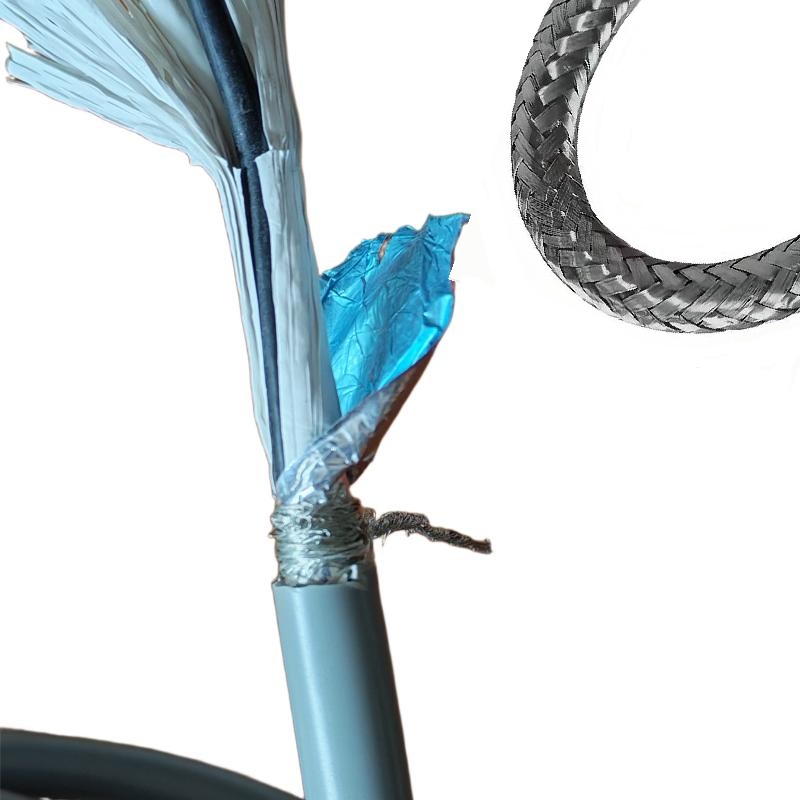
Different from power cables, encoder cables strictly require twisted-pair structure, precise impedance matching and stable working capacitance. Ordinary multi-core cables lack consistent pair twisting and shielding uniformity, which easily causes pulse loss and position deviation after long-term operation.
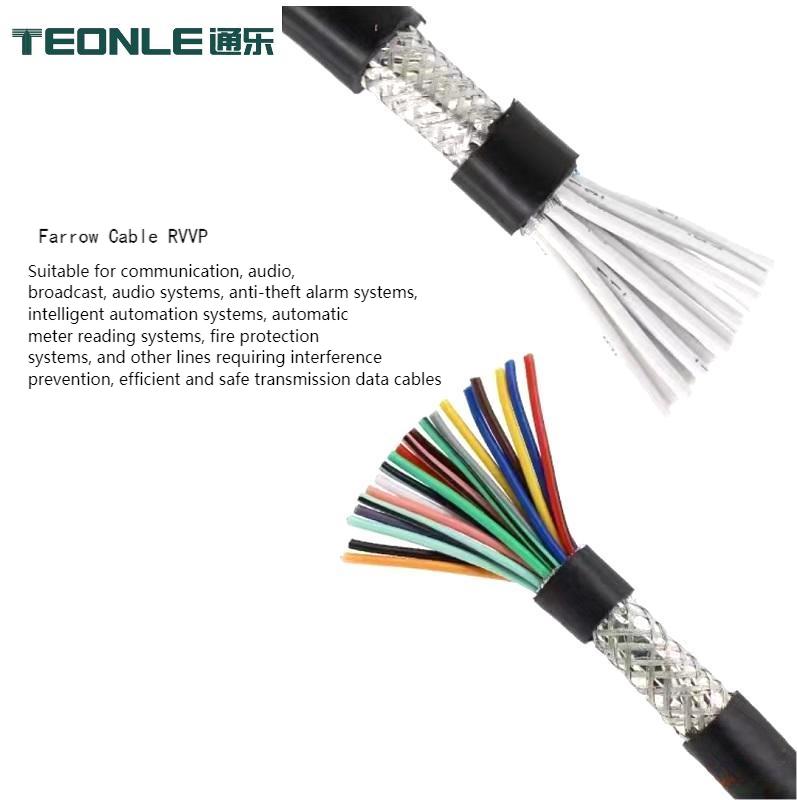
For drag chain moving environments, flexible and torsion-resistant encoder cables are necessary. The 10-14 core TRVV-SP servo encoder cable is widely used on automated equipment to ensure stable feedback during continuous bending motion.
Servo brake cables are dedicated to controlling the motor’s built-in holding brake. They normally transmit 24VDC low-current switching signals to release or lock the motor brake when the machine stops or powers off.
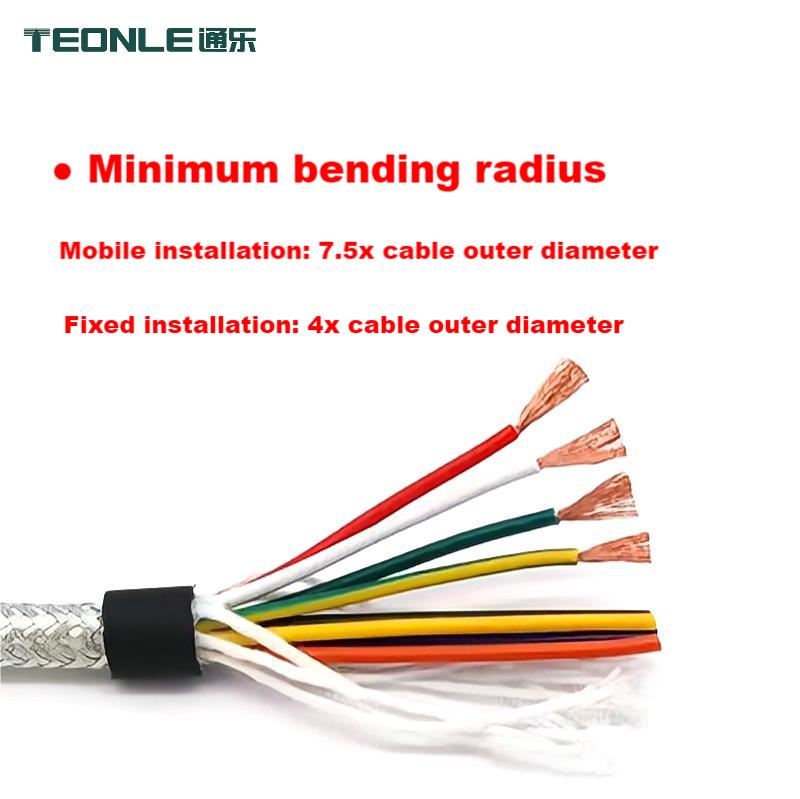
Compared with encoder cables, brake cables have simpler structure and looser requirements for twisting and capacitance parameters. However, they still need stable conduction and bending resistance in moving equipment. When routed inside cable chains, brake cables should be separated from power cables to avoid induced voltage interference affecting brake response accuracy.
In actual installation, the three cables can be quickly distinguished by signal type and application purpose:
Servo power cables — High-current power transmission, responsible for motor driving, requiring strong anti-interference shielding and high flex durability.
Encoder cables — Low-voltage precision signal feedback, determining positioning accuracy and system stability, requiring standard twisted-pair shielding.
Brake cables — Low-current switch control for safety braking, focusing on stable on-off performance and mechanical durability.
To reduce on-site failures, avoid bundling power cables and signal cables tightly together. Reserved slack inside drag chains and independent wiring separation can effectively reduce EMI interference and extend cable service life.
Servo power, encoder and brake cables are functionally irreplaceable. Correct cable selection and standardized wiring directly improve servo positioning accuracy, reduce alarm rates and lower equipment maintenance costs.
TEONLE provides complete servo wiring solutions, including high-flex servo power cables, shielded encoder cables and brake cables for drag chain applications. All cables comply with CE and UL standards and support customized core counts and shielding structures for special automation scenarios.
Related Products & Categories
Servo Cables | High-Flex Cables | Signal Cables | Cable Chain Cables

⚠️ We are offline now, please leave your cable requirements & email.
💬 Send inquiry
Reply within 2 hours

 立即沟通
立即沟通