Welcome to Shanghai Tongle Cable – International Official Website
 简体中文
简体中文
 English
Release time:2026-08-28 11:04:59 Views:
Cable‑chain cables (also known as drag‑chain cables) are widely used on linear modules, robotic axes, machine tools and automated production lines. Many users encounter premature core breakage, jacket cracking or signal dropout, even though they have purchased high‑grade flexible cables. Most failures are not caused by raw material quality alone, but come from improper installation, routing and daily application.
Below we list real‑world mistakes frequently seen in field projects, along with practical correction advice for machine builders and system integrators.
A very frequent mistake: install standard fixed‑wiring cables inside cable chains to cut costs. Ordinary multi‑core cables are designed for static installation. Their conductor stranding, inner filler and jacket compound cannot withstand millions of cyclic bending motions. They will suffer inner wire fracture within a short run‑time.
For continuous dynamic movement, you should deploy purpose‑built cable chain cables. If your machine requires heavy cyclic flexing, choose high‑flex cables with special stranded tinned copper and modified flexible jacket.
Too many cables packed tightly inside the chain is another major failure source. Cables need room to shift freely during reciprocating travel. If squeezed completely tight, cables rub against each other and the chain housing on every stroke.
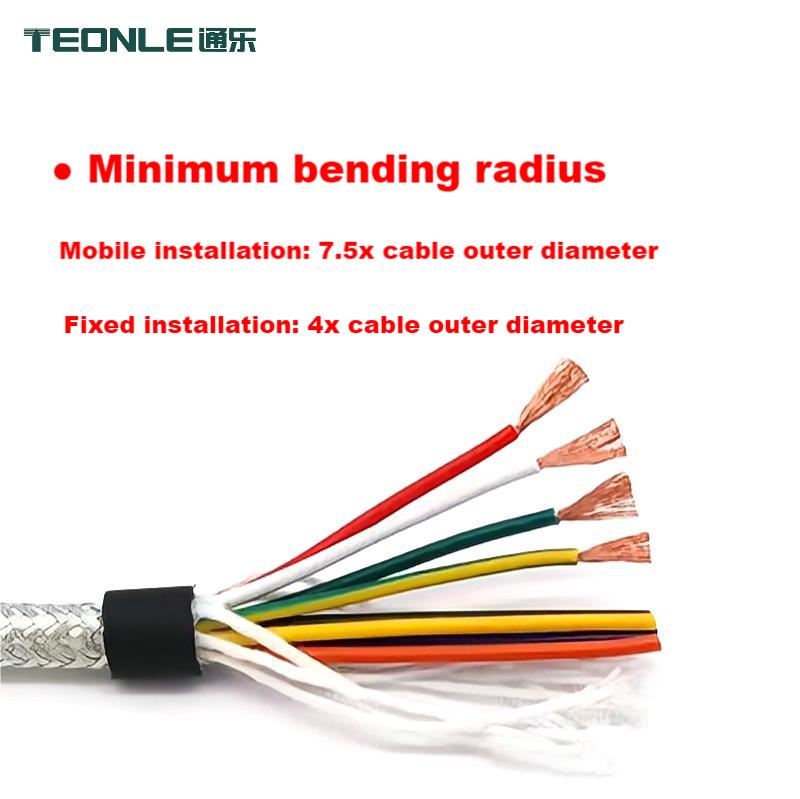
Every flexible cable defines a minimum bending radius. When installed below this value, copper conductors will bear excessive stress and break gradually. Many site technicians only consider mechanical layout and squeeze cables into sharp corners.
Always follow the manufacturer‑specified bending radius. For servo cables used inside drag chains, do not apply tighter bend radius than datasheet recommends.
High‑current power lines generate electromagnetic noise during operation. If power cables and encoder signal cables are bundled tightly together inside one chain, interference will appear. Typical symptoms include random position drift, drive alarms and unstable communication.
Best practice: place power cables and signal cables in separate chain compartments. If one single chain must be used, keep sufficient physical distance and avoid tight bundling.
Many installers pull cables fully taut to keep the layout neat. When the drag‑chain runs through full stroke, cables will be pulled hard at anchor points. Constant tensile force leads to core breakage near termination points.
Reserve appropriate slack at both fixed ends. Cables should never go under tension when the chain reaches maximum travel.
The fixed mounting point of cable chain should sit at the middle of total travel, not at one end. If you fix cables at the extreme end of stroke, one side of the cable will experience far larger bending travel, accelerating wear and fatigue failure.
Cable performance degrades quickly under oil splash, coolant spray, low‑temperature workshop or chip abrasion. Standard PU/PVC jacket will crack if exposed to incompatible cutting fluid.
TEONLE supplies a complete range of cable‑chain grade flexible cables, including servo power cables, encoder feedback cables and multi‑core control cables. Our drag‑chain cables pass millions of bending cycle tests, available with CE, UL certifications. Custom constructions for special environment requirements are supported.
Related Categories:
Cable Chain Cables|High‑Flex Cables|Signal Cables|Servo Cables

⚠️ We are offline now, please leave your cable requirements & email.
💬 Send inquiry
Reply within 2 hours

 立即沟通
立即沟通