Welcome to Shanghai Tongle Cable – International Official Website
 简体中文
简体中文
 English
Release time:2026-08-07 16:27:42 Views:
Let me be straight with you. I've been specifying and installing cables in moving cable carrier applications for over 15 years, and if you've spent any time around high-flex drag chain systems, you know the name igus. Their chainflex line basically wrote the playbook for continuous-flex cable in the automation industry. The material science behind their PVC and PUR jackets, the sheer volume of test data they've published out of that Cologne lab, the way they've documented flex cycle performance across millions of strokes — that stuff isn't marketing fluff. I've got chainflex cables running in machines that were commissioned before 2012 and they're still going strong. So when I started hearing from OEM engineers and purchasing managers about looking for an igus chainflex alternative, my first reaction was skeptical. But after walking through enough production floors and sitting in enough budget meetings, I get it. The technical case for chainflex is solid. The business case for every single project, every single time? That's where the conversation gets more nuanced.
Here's a scenario I saw play out at a packaging machinery builder outside Milan last year. Their lead electrical engineer had a machine build scheduled for a major food and beverage customer — a complete case packer line with 14 axes of servo motion. The mechanical design was locked, the BOM was finalized, and they had a firm ship date 10 weeks out. Then procurement flagged the cable order. The specific chainflex servo cable they needed, a 4G1.5 with a 2x2x0.34 signal pair for the feedback channel, was on a 10 to 12 week lead time from the German warehouse. That wasn't a delay — that was a full stop. The machine couldn't be wired, couldn't be FAT tested, couldn't ship. Penalty clauses started kicking in at week 11.
This isn't a rare exception. Anyone sourcing chainflex in volume for North American or Asian assembly floors has run into this. Standard catalog items sometimes move faster, but once you get into the specific cross-sections, the combination power-plus-feedback constructions, the shielded versions with 85% braid coverage that you actually need for servo drives in noisy EM environments — those are the ones that sit on allocation. And when you're an OEM building 20 or 30 machines a month, a 12-week cable lead time doesn't just delay one order. It cascades through your entire production schedule. Your cable carrier supplier can deliver in two weeks. Your connectors come from stock. Your drives and motors arrive on a pallet. But the whole line waits because the drag chain cable is somewhere between Cologne and your receiving dock.
I had a plant engineer at an automotive Tier 1 tell me straight up: "We don't doubt the cable will last. We doubt we can get it before our line is supposed to be running." That's a supply chain problem, not a product problem. But it's a problem that drives a lot of very smart engineers to start evaluating a chainflex servo cable replacement that can be manufactured and shipped in a fraction of the time.
Let's talk about minimum order quantities because this one hits small to mid-size OEMs the hardest. If you're a large automotive line builder consuming 50,000 meters a year, you're a key account. You get allocations, you get favorable pricing, you get somebody on the phone. But if you're a specialty machine builder doing a custom automation cell — maybe a robotic deburring station, a vision-guided pick and place, a small assembly line for medical devices — your annual cable usage might be 2,000 to 5,000 meters total across all sizes. And for a specific non-stock construction, the MOQ might be 1,000 meters or more.
I worked with a small integrator in Wisconsin last year that needed 280 meters of a shielded encoder cable for a prototype CNC router. The catalog part number was technically available, but the MOQ for a factory order was 500 meters, and the stock length was 100 meters with a 6-week wait for the next batch. They ended up buying 100 meters, splicing in a different cable for the test phase, and then re-cabling the whole thing when they went to production. That's not engineering. That's working around a supply constraint.
This is where a lot of the igus encoder cable substitute conversations start. Not because engineers want to compromise on flex life or shielding performance. Because they need 300 meters of a 6-pair shielded cable with Class 6 stranding and a PUR outer jacket, in a custom gray color to match their machine branding, with their company logo printed on the jacket every meter, and they need it in three weeks for a trade show demo. The big catalog houses can't always flex that way. A cable manufacturer that actually runs their own extrusion lines can.
Speaking of custom — let me tell you about a cable request I got last quarter. A battery equipment manufacturer was building formation and grading racks for EV prismatic cells. They needed a continuous-flex cable for a gantry system that moved charging probes back and forth across battery trays. The electrical requirements were specific: 12 power conductors at 2.5mm² for the charging circuits, plus 8 signal pairs at 0.5mm² for temperature sensing and voltage monitoring, plus an overall braid shield with at least 80% coverage because the switching power supplies on that equipment generate a horrendous amount of EMI. The outer jacket needed to be a specific orange color for high-voltage DC identification per their plant safety standards. They wanted sequential meter marking that matched their wiring harness documentation.
That's not a catalog part. That's a custom servo encoder cable with a very specific hybrid construction. And the lead time and cost from the premium European brands for that kind of custom build? Let's just say the quote came back with a price per meter that made the project manager choke on his coffee, and a lead time that pushed the machine delivery out by a full quarter.
The reality is that most cable catalogs are built around standard configurations: 4G1.5, 4G2.5, 4G4, maybe a 2x2x0.34 pair for feedback. But modern automation is pushing into hybrid cables that combine power, signal, and even Ethernet in a single jacket. It's pushing into special jacket compounds for weld splatter environments, for coolant exposure, for low-temperature cold storage applications. It's pushing into custom color codes, custom print strings, custom reel lengths. When your machine doesn't fit the catalog, you're not being difficult — you're designing for your actual application. And you need a cable partner who can build what you actually need, not just sell you what they happen to have on the shelf.
Let's run some numbers, because this is where the purchasing managers earn their keep. I'm going to use round figures here because actual pricing varies by distributor, region, copper market, and volume — but the ratios hold. A typical chainflex servo cable in the 4G1.5 + 2x0.75 size range might run you somewhere in the neighborhood of $9 to $14 per meter, depending on the specific series and shielding. If you're an OEM consuming 5,000 meters a year of that cable across your machine builds, that's $45,000 to $70,000 annually for one cable size. And that's before you add in the other six or seven cross-sections on your BOM.
Now, I know what the chainflex sales engineer will tell you — and they're not wrong. The total cost of ownership matters. A cable that lasts 10 million flex cycles instead of 2 million saves you warranty claims, saves you field service calls, saves you the downtime of a ripped-out cable on a production line. That argument is absolutely valid for the end user running the machine 24/7 for five years. But here's the tension: the OEM building the machine doesn't pay the warranty claim on a cable failure three years after shipment if the spec was met. The OEM does, however, pay the upfront material cost on every single machine they ship. And when they're quoting against three competitors for a 20-machine order, a 30% cable cost difference on a $12,000 cable package per machine is $72,000 across the order. That's the difference between winning and losing the bid.
I've sat in too many meetings where the engineering team wants the premium brand because they've never had a failure, and the purchasing team is pointing at a competitor's quote that's $1,800 per machine cheaper. The answer isn't always "spend more." The answer is finding a servo power cable that meets the actual flex requirements of the application — not every machine needs 10 million cycles; some only need 2 million because the axis only moves 400 times an hour — with the right shielding performance, the right bend radius, the right approvals, at a price point that lets the OEM stay competitive.
Let's get into the engineering weeds for a minute because this is where you can make an intelligent substitution instead of just buying on price. If you're evaluating a drag chain cable alternative, here's what actually moves the needle on performance and service life.
Stranding class. This is non-negotiable. You need Class 6 fine-stranded copper per IEC 60228 or VDE 0295. Class 5 (the normal "flexible" stranding you see in standard control cable) will work-harden and break in continuous flex applications. The wire diameter per strand matters too — for really tight bend radii, you want strand diameters in the 0.1mm to 0.2mm range. A cable built with Class 6 stranding, properly laid up with the right pitch length, will deliver 5 to 10 million flex cycles without conductor breakage. I've seen cheap "high-flex" cables built with Class 5 stranding that failed in 60,000 cycles. That's not a savings; that's a time bomb.
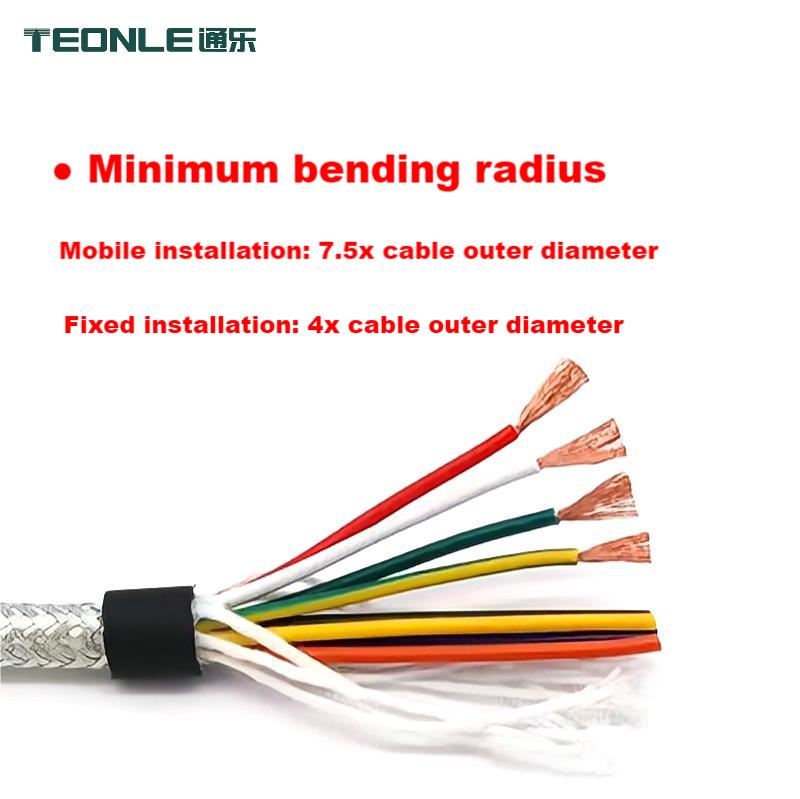
Bend radius and cable carrier geometry. The old rule of thumb for dynamic applications is 7.5x the cable outer diameter for the minimum bend radius inside the carrier. Some premium cables are rated for 5x or even 4x OD, but that's where the premium stranding and jacket compounds earn their keep. If your cable carrier has a bend radius that gives you 10x OD clearance, you don't necessarily need the cable rated for 5x. You're paying for performance you can't use. Match the cable rating to your actual mechanical geometry.
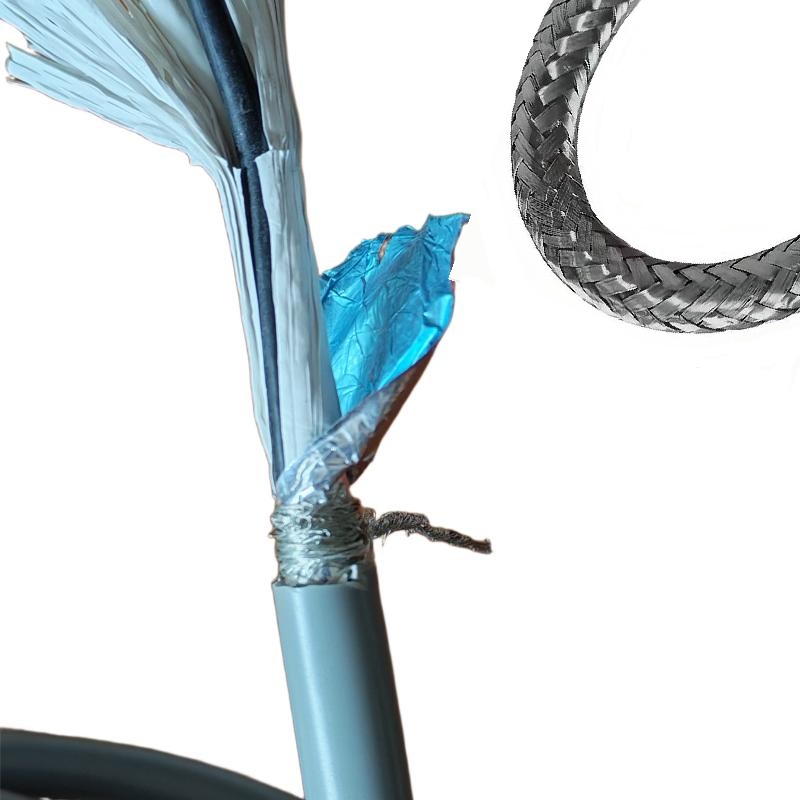
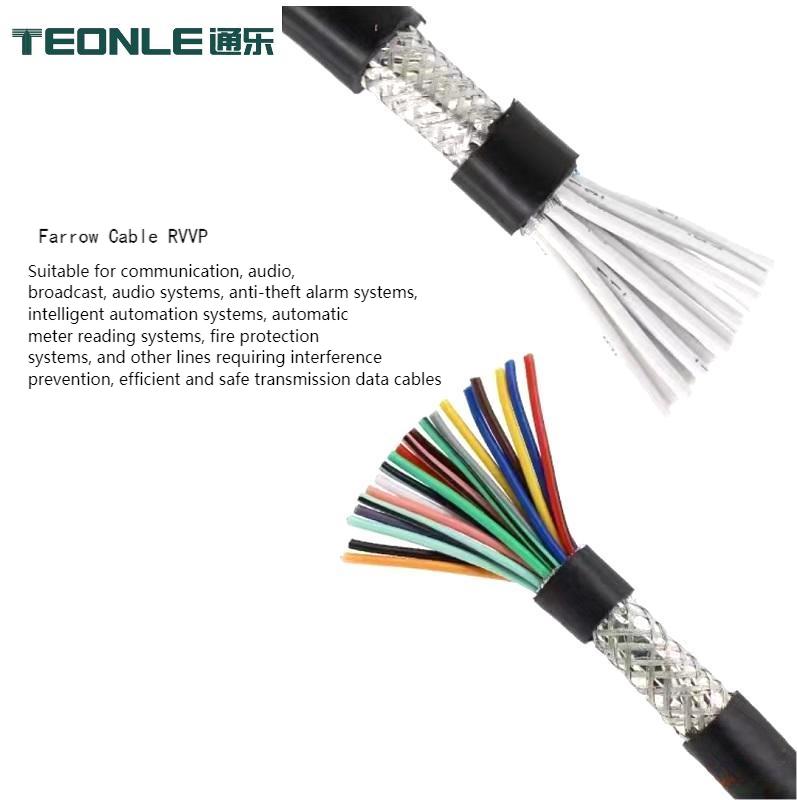
Shielding effectiveness. For servo and encoder applications, EMI shielding isn't optional. The inverter-driven motors create common-mode noise that will absolutely wreck your encoder position feedback if you don't contain it. Look for 85% braid coverage minimum on the overall shield, tinned copper for corrosion resistance, and consider individual pair shielding for encoder signals running alongside motor power. A lot of the value-brand cables skimp here — 65% coverage, aluminum foil only, no drain wire — and that's where you get intermittent position faults that take three days to debug on a running machine. The good alternative sources get this right. They spec 85% braid coverage because they know the EMI environment in a real cabinet, not a clean lab.
Jacket material. PVC is fine for standard indoor industrial environments, temperatures up to about 80°C, no oil exposure. PUR (polyurethane) is the upgrade you need for weld spatter, cutting fluids, coolant mist, low-temperature flexibility, and abrasion resistance when the cable is rubbing against divider bars in the carrier. A lot of the "will it last" question comes down to matching the jacket compound to the actual environment. A PVC-jacketed cable in a welding cell will crack in a year. A PUR-jacketed cable in a clean packaging machine is overkill that you're paying for. Be honest about the environment and spec accordingly.
Voltage rating and approvals. For servo power circuits, 0.6/1kV rating is standard and gives you the insulation thickness you need for the voltage spikes from VFD outputs. UL recognition, CE compliance, maybe even CSA for the North American market — these are table stakes. If you're building machines for export, your cable needs the right marks on the jacket. Any legitimate alternative source will have these; if they don't, walk away.
Core lay and twist length. This is the part you can't see on a spec sheet but it makes all the difference. The conductors inside a continuous-flex cable aren't just bundled straight — they're twisted in layers with specific pitch lengths, and the layers are often contra-twisted so the cable moves as a unit instead of having internal conductors bind against each other. This is where the real manufacturing know-how lives. igus has this dialed in through decades of testing. The better alternative manufacturers have also invested in the tooling and process control to get this right. The cheap stuff? They just bunch the conductors and extrude the jacket. It works for a while, then the internal friction fatigues a strand, and you get a broken conductor at the bend point.
Here's how I approach this with the OEMs I work with. First, be honest about the duty cycle. Is this a high-speed gantry on a packaging line running 24/6 for the next seven years? That's where the premium chainflex product pays for itself, and I'll spec it without hesitation. Is this a slow-moving linear axis on a specialty machine that runs 8 hours a day, five days a week, with a 3-year product lifecycle? That's where a well-constructed alternative cable from a manufacturer that understands continuous-flex design will meet the requirement and save you real money.
Second, look at the total supply chain picture. If the premium cable is in stock at your local distributor and you can get it tomorrow, the price difference might be worth the convenience. If you're looking at 10 to 12 weeks and a 1,000-meter MOQ for a part you need 200 meters of next month, that's a different equation.
Third, don't treat "alternative" as "cheap." There are garbage cables out there that will fail and cost you far more in downtime than you saved on the purchase order. But there are also legitimate cable manufacturers — companies that have been building industrial cable for decades, that understand stranding and shielding and jacket compounds, that have their own test equipment — that can deliver a absolute encoder cable or continuous-flex power cable that meets the same IEC and VDE standards, that will deliver the flex cycles your application actually requires, and that can do it on your timeline and your volume.
The smart play isn't to standardize on one brand for everything. It's to understand what each cable in your BOM actually needs to do, and match the cable to the application. Sometimes that's chainflex. Sometimes it's something else. The goal is a machine that runs reliably, ships on time, and costs enough to win the order but still leaves margin on the table.
If you're sitting on a BOM right now with lead times that don't work, or MOQs that force you to buy twice what you need, or custom specs that the catalog houses can't touch, send us your drawings and your cable schedule. We'll look at the flex requirements, the shielding needs, the jacket material, the bend radius, and tell you honestly whether we can build a chain cable alternative that meets your spec. No hard sell — just a straightforward engineering review and a quote. If it makes sense for your project, great. If your application really does need the premium catalog part, we'll tell you that too. That's the kind of conversation you can only have with somebody who's actually stood on a factory floor at 2 a.m. troubleshooting a broken encoder cable and knows exactly what's at stake.

⚠️ We are offline now, please leave your cable requirements & email.
💬 Send inquiry
Reply within 2 hours

 立即沟通
立即沟通